「堀場信吉教授還暦記念論文集」として発行された第20巻の冒頭、歸山先生による堀場先生の紹介です。
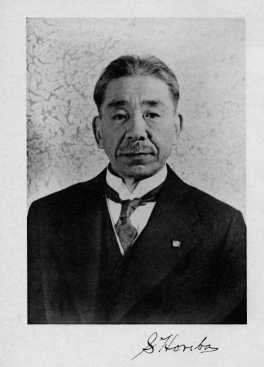
This volume is dedicated to Prof. Shinkichi Horiba in honour of the sixty-first anniversary of his birth by his pupils and the members of the Committee under his presidency.
Prof. Shinkichi Horiba was born in Kyoto as the eldest son of a good family on November 29, 1886. His buddhistic family thinking highly of earnestness and duty was most suitable for fostering his intelligence. Finishing the whole course of the Kyoto Second Middle School, he entered the Third High School and then the Kyoto Imperial University to take a course in chemistry as pure science. In those days the university had no college of science alone, but a combined college of science and engineering. Prof. S. Horiba's graduation thesis was "On the Equilibrium in the System: Water, Ethylalcohol and Ethylether" (1911). Under the guidance of Prof. Yukichi Osaka who had investigated the Phase Rule, the essential problem of the time in physical chemistry, he devoted his third year of the college to the study. Being the first paper, the thesis would be a remembrance of his college life. When he went abroad in his later years, he found this work of his already known to foreign scholars. During the World War I, in connection with the solvent recovery, his work arrested much attention. It is needless to say that his thesis was written from tho purely scientific point of view.
After his graduation he advanced to the post-graduate course. One year later he served in Electric Wire Manufacturing Factory of the Sumitomo Co., whose President was Mr. Masaya Suzuki. It gave him the opportunity to get out of the tower of ivory. His service in the company resulted in his accepting large donations from the company as his research funds. After resigning the post, he resumed his research on physical chemistry in Prof. Osaka's laboratory. Being appointed a lecturer, he promoted to an assistant professor. He was ordered to Europe and America for physico-chemical studies. He mostly stayed in England and Holland. After five years' sojourn (1919-1923) he returned home to be a professor. Some years later, he occupied the chair of physical chemistry, in place of Prof. Y. Osaka who reached the age limit and retired. In 1928, when the Institute for Chemical Research was established in the Kyoto Imperial University, he became a member of the institute.
Prof. Horiba's contributions to physical chemistry cover a wide range, particularly to chemical kinetics which was already in his mind during his stay in Europe. In 1927, he proposed a method of measuring reaction velocities by the heat of reaction - "Thermal Analysis of Reaction Velocity". This method was applied to the reaction between chlorine and hydrogen (with Dr. Ichikawa) and later completed by Dr. Tamura (1937).
In 1937, Prof. S. Horiba was bestowed the Imperial Prise for his studies on "Thermal Analysis" of chemical kinetics. Its application was extended to gaseous reactions, reactions of atoms or radicals (by Dr. Shida). The same method was applied even to reactions in solution, and the future development will be fruitful.
In the field of catalytic reactions, the decomposition of carbon monoxide by reduced nickel was proved to be the stepwise process from his own considerations (with Dr. Ri, 1931) and these considerations were applied by many pupils on contact catalytic reactions with prominent results. As to its application to chemical industry, there was a study of a catalyser for synthesis of ammonia pursued by Dr. Kiyama (1939).
In the field of chemical kinetics, furthermore, Prof. Horiba began to investigate the explosive reaction of gases in 1940 (with Dr. Goto). Several years before his retirement, he took an interest in ultra high pressure chemistry. Though he himself made no experiments on this line, Dr. Kiyama of his laboratory made a 5,000 atm. compressor under extremely unfavorable conditions as during the World War II, which gives promise of further development of high pressure chemistry. His laboratory in the Institute for Chemical Research laid stress upon colloid chemistry. The photochemical nature of colloid was first studied and then the Weigert effect of various colloids (with Dr. Kondo, 1927), the change of the osmotic pressure by light (1930), the Brownian movement by light. His valuable contributions to applied colloid chemistry were the investigation of the method of preparing organosol, that is, dispersing such metals as gold, silver and mercury in oils in a colloidal state (with Mr. Odagiri, 1928). The organosol thus made has been used as medicine, for example, gold organosol for leprosy or lupus, and mercury organosol for ship bottom paint. The latter led even to satisfactory preparation of ship bottom paint without mercury (with Mr. Shimomoto), which now holds many patents. The studies he set hand to have been further pursued by his pupils, and under his guidance more than 200 reports have been already appeared in this journal.
That he could make various kinds of studies as a director would be ascribed to his own magnanimous character and his laboratory to accomodate his students and post-graduates. The bulk of research expenses was donated to him as a scholarship fund. His laboratory had more than forty investigators at one time. What he paid close attention to was to create a comfortable atmosphere of enjoying studies for younger investigators. It happened then that Eizaburo Fujii, who was an entire stranger to him, presented him a large sum of donation as the research expenses for his young workers. E. Fujii was Jokichi Takamine's younger brother, being a business man. This enabled him to establish the Physico-Chemical Society of Japan. "The Review of Physical Chemistry of Japan" edited hitherto by him was transferred to the society as the organ, which afforded younger investigators the opportunity to publish their original papers. And the Fujii scholarship was instituted from his donations.
He held an additional post in Tokyo Institute of Technology. He did much for his university as a member of University Senate, the head of the Institute for Chemical Research, and that of the College of Science, and also rendered great services for the academic world as a powerful member of Research Conference of National Arts and Science, and a member of Japan Society for the Promotion of Scientific Research.
His laboratory was always full of young investigators, and many pupils who studied under his guidance were sent to the society as scientists. Twenty pupils of his have received doctorate: ten are the professors or assistant professors of universities and those in factories or institutes occupy important positions.
Having attained just the age of sixty one, he has retired from the platform according to the custom of his University, and also from the post as the editor of this journal. And he will perhaps give up his relation to any chemical organizations after the expiration of his term of the Chemical Society of Japan as the president.
May he add greatly to his life work for our pleasure and guidance and may he enjoy ife as fully in future as he has done in the past. (R. K.)